
Search
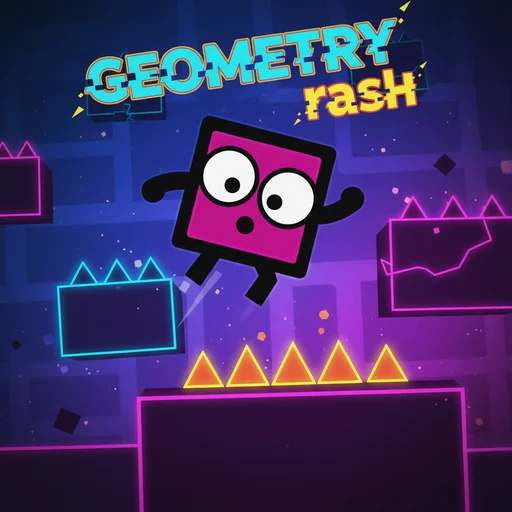
Geometry Rash stands as one of the most exhilarating browser-based platformer games available online today. This fast-paced action game combines simple yet addictive mechanics with challenging obstacles, making it an instant favorite for players seeking quick gaming sessions and intense reflex-based gameplay. Whether you're accessing it through your desktop browser, smartphone, or tablet, Geometry Rash delivers consistent, engaging gameplay without requiring any downloads or complex installations. The game represents a modern take on classic rhythm-based platformers, capturing the essence of precision-timing challenges while maintaining an accessible entry point for casual gamers.
Geometry Rash is an arcade-style platformer game developed by Vi Games, with the HTML5 version released on December 4, 2019. The game falls into the broader category of endless runner games, though it features distinct levels rather than a purely infinite experience. Created as an alternative to other geometric-themed platformers, Geometry Rash has built a dedicated player base through its combination of intuitive controls and escalating difficulty.
Developer: Vi Games
Release Date: December 4, 2019
Technology: HTML5
Platform: Web Browser (Desktop, Laptop, Mobile, Tablet)
Genre: Platformer, Arcade, Rhythm Action
Cost: Completely free to play with no hidden fees, in-app purchases, or subscription requirements
The game's popularity stems from its straightforward accessibility combined with genuine challenge. Players control a geometric cube character navigating through obstacle-filled environments, requiring quick reflexes and pattern recognition to progress. Unlike many modern games, Geometry Rash maintains a philosophy of pure skill-based gameplay, free from pay-to-win mechanics and unnecessary complications.
Geometry Rash operates on a simple premise: your geometric character moves forward automatically, and your only responsibility is managing jumps and directional changes to avoid obstacles. The game features a non-random design, meaning each level remains consistent across playthroughs, allowing players to memorize patterns and improve through practice.
The fundamental mechanic involves clicking or tapping the screen to execute actions, whether jumping over spikes, changing gravity, or activating power-ups. This simplicity masks the game's true challenge—the precision timing required to navigate increasingly complex obstacle arrangements.
Geometry Rash offers multiple progression systems depending on the hosting platform. Most commonly, players encounter 8 to 15 distinct levels, each introducing new challenges and mechanics. Some versions feature an endless mode where players strive for the highest score possible. The game employs a graduated difficulty curve, where early levels introduce basic obstacle avoidance and later levels combine multiple mechanics simultaneously.
The progression design ensures that newer players can build confidence on manageable challenges before facing the intense demands of advanced stages. Each level completion unlocks new content and provides a satisfying checkpoint marker in the overall experience.
Throughout Geometry Rash, players encounter diverse obstacles designed to test different reflexes and reaction patterns:
Spikes: Stationary triangular hazards that instantly end your run upon contact. These form the primary obstacle type throughout the game, appearing in various patterns and configurations.
Moving Platforms: Dynamic elements that shift position or movement speed, requiring players to time jumps precisely to land safely.
Gravity Portals: Environmental triggers that flip gravity direction, forcing players to reorient their movement strategy mid-run.
Rotating Blades: Circular obstacles that spin unpredictably, demanding split-second timing to navigate safely.
Geometric Walls: Flat obstacles requiring vertical jumps to clear.
Playing Geometry Rash immerses you in a rhythmic experience where music synchronizes with obstacle patterns, creating a flow state for skilled players. The game employs bright, colorful geometric graphics with clean lines and minimal design, ensuring players can track obstacles clearly without visual clutter.
The game gradually escalates through distinct phases within each level:
Early Stage (0-37%): Introduction to basic cube movement, simple spike patterns, and initial robot/orb mechanics. This section familiarizes new players with controls and fundamental concepts.
Mid-Stage (38-72%): Introduction of multiple character forms, including wave, ball, UFO, and cube variations. Obstacle complexity increases significantly, with faster speeds and pattern variations demanding refined timing skills.
Late-Stage (73-100%): Final wave, ship, and cube sections demand laser-focused concentration and near-flawless timing. These segments represent the true test of player skill and pattern memorization.
What makes Geometry Rash compelling is the feedback loop it creates. Each failure represents a learning opportunity rather than punishment, as the consistent level design means every attempt teaches players more about obstacle positions and timing requirements. This produces the classic "one more try" mentality that makes the game highly addictive.
The 2D side-scrolling perspective maintains visual clarity while delivering the fast-paced action that defines the experience. Combined with a pulsating electronic soundtrack, the game creates an adrenaline-fueled experience that rewards both quick reflexes and patient pattern analysis.
Geometry Rash's HTML5 foundation ensures universal compatibility across modern web browsers. The game runs seamlessly on:
Desktop: Windows and Mac systems using Chrome, Firefox, Safari, Edge, or any HTML5-compatible browser
Mobile: iOS and Android devices through browser access
Tablets: Full responsiveness on iPad and Android tablets with touch controls
The game functions identically across device types, though control methods vary:
PC/Laptop: Mouse click or W-key activation
Mobile/Tablet: Touch screen tap for jumping
The unified experience means you can start playing on desktop and seamlessly transition to mobile without losing progress on many hosting platforms.
HTML5 technology provides several player advantages:
No downloads required — gameplay begins immediately upon visiting the hosting website
No plugin dependencies like Flash or Java
Consistent performance across different browsers and operating systems
Regular playability without concerns about outdated software versions
Navigate to any Geometry Rash hosting platform using your preferred web browser. Click the "Play" button to begin immediately. The game starts with a brief tutorial demonstrating the single fundamental control: making your character jump.
Primary Control: Single-button input
The simplicity of controls makes the game accessible to casual players while creating a high skill ceiling through mastery of timing and pattern memorization.
The auto-movement mechanic eliminates movement complexity, focusing all challenge on obstacle avoidance timing.
Geometry Rash intentionally uses minimal controls to reduce the learning curve while maximizing skill differentiation:
| Control | Action | Device |
|---|---|---|
| Left Mouse Click | Jump/Action | PC/Laptop |
| W Key | Jump/Action | PC/Laptop |
| Up Arrow Key | Jump/Action | PC/Laptop |
| Screen Tap | Jump/Action | Mobile/Tablet |
The single-control design means virtually anyone can begin playing within seconds, but mastering rhythm and timing takes substantial practice. This accessibility-to-complexity ratio represents core game design elegance.
Success in Geometry Rash fundamentally depends on precise timing. Listen carefully to the background music and synchronize jumps with the rhythm. The musical score isn't merely atmospheric—it provides auditory cues for anticipating obstacle placements. Wearing headphones dramatically improves rhythm recognition.
Since levels remain consistent across playthroughs, dedicate practice sessions to memorizing obstacle patterns. Identify the most challenging sections and focus repeated practice attempts on those specific areas. Most skilled players report that breakthrough moments occur after 20-50 practice attempts on difficult sections.
Maintain calm under pressure during difficult sections. Many failures result from panic rather than impossible timing requirements. Take deep breaths between attempts and maintain focused concentration. Short gaming sessions (15-20 minutes) typically produce better results than extended sessions, where fatigue impacts reflexes.
If available on your hosting platform, practice mode allows replaying specific level sections without restarting from the beginning. Use this feature extensively to target weak spots and build confidence. Repeated practice on single sections develops muscle memory more effectively than full-level attempts.
Identify visual patterns and color changes that predict obstacle transitions. The game designers use consistent visual language, with particular colors and shapes appearing before specific mechanics. Developing visual pattern recognition complements rhythm-based timing.
Collect stars and other collectible items whenever safely possible, as these unlock character customization options and provide scoring bonuses. While not affecting core gameplay, collecting items adds secondary objectives that improve overall scores.
Rather than reacting to individual obstacles, develop a rhythm-based approach where your jumping becomes automated after memorization. Top players describe entering a "flow state" where decisions happen intuitively rather than consciously. This develops through sustained practice and pattern familiarity.
Geometry Rash delivers 15 progressively difficult levels, each introducing new mechanics and obstacle combinations. The structured progression ensures both new players and experts find appropriate challenge levels.
Collect stars throughout levels to unlock unique cube character designs and cosmetic variations. While purely cosmetic, these unlockables provide achievement milestones and visual rewards for dedicated play.
Depending on the hosting platform, versions may include:
Story Mode: Progressing through structured levels with increasing difficulty
Endless Mode: Continuous challenges focused on achieving the highest score possible
Practice Mode: Replayable sections without consequence for skill development
The integration of music with obstacle patterns creates a rhythm-action experience distinct from pure platformers. Each level features specifically composed or selected music that synchronizes with obstacle patterns.
The minimalist geometric visual design emphasizes clarity during fast-paced gameplay. Bright neon colors distinguish different elements while maintaining visual cohesion. The modern aesthetic appeals to both children and adults.
Consistent level design means players can replay levels indefinitely, always having the opportunity to improve scores and execution. The non-random nature eliminates luck factors, making every success purely skill-based.
Complete access to all levels and gameplay without hidden costs or progression blockers. No advertisements interrupt gameplay on most platforms, creating an unobstructed experience.
Advanced levels introduce temporary character form changes, including ships and robots. Each form possesses unique physics and control requirements, demanding that players adapt their approach mid-level.
Certain levels introduce gravity-flipping mechanics where up becomes down and vice versa. These sections fundamentally alter spatial reasoning requirements and create memorable gameplay variance.
The game gradually increases speed throughout each level, demanding improved reaction times as progression continues. This graduated pacing ensures sustained challenge throughout gameplay.
Later levels combine multiple obstacle types simultaneously, requiring players to manage complex decision-making at rapid speed. This creates the genuine difficulty spike that separates casual players from dedicated practitioners.
For players enjoying Geometry Rash, numerous alternative platformers deliver comparable experiences:
Geometry Dash Series: The original and most popular franchise within this genre, featuring extensive player-created custom levels
Tunnel Rush: Similar speed-based platforming with three-dimensional environments
Slope: Fast-paced rolling obstacle avoidance game
Run 3: Continuous running through dynamic environments with gravity mechanics
Crazy Roll 3D: Three-dimensional alternative combining rolling and obstacle avoidance
Death Run 3D: Team-based platforming with competitive elements
Ninja Dash Run: Platformer combining martial arts aesthetics with obstacle courses
Beat Blade: Dash Dance: Rhythm-action game emphasizing musical synchronization
Dub Dash: Music-based platformer with comparable single-button controls
Each alternative offers distinct visual styles and mechanical variations while maintaining the core appeal of reflexes-based platforming.
While Geometry Rash maintains generally stable operation, players have reported occasional issues:
Hitbox Inconsistencies: Rare instances where spike hitboxes appear misaligned with visual representations, occasionally allowing unintended collisions or passes
Audio Sync Issues: Music sometimes continues playing after level pause/resume, creating rhythm desynchronization
Visual Clipping: Occasionally, character sprites clip through backgrounds or obstacle visuals, though this rarely affects collision detection
Level Loading: Rare instances where levels fail to load completely, requiring a page refresh
These issues remain minimal on officially hosted platforms, with most player experiences remaining bug-free. Reporting technical issues to platform administrators typically results in swift resolution.
"Unblocked" refers to accessing Geometry Rash on restricted networks where gaming sites face blocking (schools, workplaces). Several methods facilitate unrestricted access:
Multiple dedicated platforms host Geometry Rash specifically for unrestricted browser access:
These platforms provide identical Geometry Rash gameplay while avoiding network restrictions.
Accessing gaming content on school networks violates most acceptable use policies. However, using Geometry Rash as an educational tool during computing classes for learning about HTML5 technology, browser game development, or reflex-based learning represents legitimate educational use.
The HTML5 architecture makes Geometry Rash less susceptible to network blocking compared to plugin-dependent games. Many unblocked versions simply represent the standard game hosted on different domains.
Geometry Rash is a free-to-play browser-based platformer game where players control a geometric cube navigating through obstacle-filled levels. Success requires precise timing, quick reflexes, and pattern memorization.
Most Geometry Rash versions feature 15 main levels, though some hosting platforms offer 8-level versions. Some platforms include endless modes beyond structured levels.
Yes, Geometry Rash is 100% free to play with no hidden costs, in-app purchases, or subscription fees. All levels and features remain accessible without payment.
Absolutely. Geometry Rash functions seamlessly on smartphones and tablets through web browser access. The touch controls adapt perfectly to mobile platforms without requiring dedicated app installation.
Desktop players use the left-click mouse or W/up-arrow key input. Mobile players simply tap anywhere on screen. This single-button simplicity makes the game instantly accessible to all players.
Collect stars scattered throughout levels to unlock character cosmetics and cube designs. Accumulating specific star counts unlocks new appearance options. Character unlocks remain purely cosmetic without gameplay impact.
Geometry Rash primarily exists as a browser game. However, some similar games with identical or comparable mechanics appear on Google Play and Apple App Store under varying titles. The official Geometry Rash typically remains web-based.
Persistent difficulty often indicates insufficient pattern memorization. Use practice mode to focus on troublesome sections, listening for musical rhythm cues. Most breakthroughs occur after 20-50 focused attempts. Consider taking breaks between sessions, as fatigue impacts reflexes.
The primary Geometry Rash game doesn't feature user-generated level creation. However, similar games like Geometry Dash include extensive level editor functionality. Some Geometry Rash hosting platforms may offer custom-level features depending on implementation.
Difficulty stems from multiple factors: precise timing requirements, combined obstacles in later levels, gradual speed increases, and counterintuitive mechanics like gravity inversion. Success requires consistent practice and refined muscle memory development.
Typical sessions range from 5-20 minutes, depending on skill level and available time. Quick gaming sessions produce better results than extended sessions, where fatigue impacts performance. Many players enjoy multiple short sessions rather than single extended attempts.
While primarily entertainment-focused, Geometry Rash develops reaction time, pattern recognition, and rhythm coordination skills. Educational platforms like HoodaMath include Geometry Rash specifically for developing reflexes and coordination.