
Search
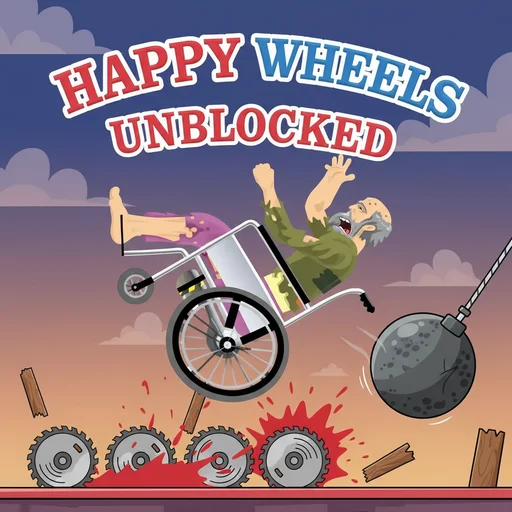
Happy Wheels stands as a legendary browser game that revolutionized online gaming with its absurd ragdoll physics and creativity-driven level design. Released in 2010 by developer Jim Bonacci under Total Jerkface Studios, Happy Wheels transformed browser gaming by combining brutal physics simulation with dark humor, creating an experience where failure is as entertaining as success. The game survived the death of Adobe Flash in 2020, emerging reborn as a JavaScript version that introduced millions of new players to the joyous chaos of controlling inadequately prepared racers through deadly obstacles.
Whether you're a nostalgic player returning after years away or a newcomer discovering ragdoll physics gaming for the first time, Happy Wheels Unblocked provides unlimited access to one of the most addictive casual games ever created. With 16 unique characters, millions of user-created levels, and a robust level editor, Happy Wheels offers gaming experiences limited only by your imagination and pain tolerance.
This comprehensive guide covers everything you need to master Happy Wheels, from character selection and control mechanics to advanced strategies, level creation, and how to access the game unblocked from anywhere.
Happy Wheels emerged in 2010 as a Flash-based browser game that fundamentally changed how players perceived online casual gaming. Created by Jim Bonacci at Total Jerkface Studios, the game combined innovative physics-based ragdoll mechanics with creative level design, establishing a new standard for browser entertainment.
The game's core appeal stems from its brutal honesty: you control characters who are absolutely unprepared for the obstacles they face. Wheelchair Guy rides a jet-powered wheelchair. Irresponsible Dad brings his son on a bicycle through deadly courses. An effective shopper navigates on a mobility scooter. Rather than heroic fantasy, Happy Wheels celebrates the comedy of disaster, where each failure triggers genuine laughter rather than frustration.
Happy Wheels achieved massive cultural significance, accumulating over 1 billion plays across platforms. The game influenced an entire generation of physics-based games and inspired countless YouTube content creators to build audiences around Happy Wheels gameplay and level creation.
When Adobe Flash died in December 2020, Happy Wheels could have disappeared into internet history. Instead, developer Jim Bonacci partnered with Goodboy Digital to create a JavaScript port that preserved the original game while introducing performance improvements and mobile compatibility. The official totaljerkface.com now hosts the JavaScript version, maintaining backward compatibility with the original Flash game's level database, ensuring 14+ years of user-created content remains playable.
Today, Happy Wheels remains active with regular updates and optimizations, hosting a thriving community creating thousands of new levels monthly. The game is available through multiple platforms, including official browser hosting, emulated Flash versions, mobile apps, and community-maintained unblocked mirrors, ensuring accessibility regardless of network restrictions.
Happy Wheels operates on Box2D, a sophisticated 2D physics engine that simulates realistic rigid body dynamics, gravity, collision detection, and momentum transfer. Every movement your character makes, every object they collide with, and every attempt to navigate levels follows consistent physics calculations, creating a system where understanding physics fundamentals directly translates to improved gameplay.
The physics engine drives the game's unique appeal: unpredictability coupled with logical consistency. The same physics that allows spectacular victories also creates hilarious disasters. A perfectly-timed leap that should carry you to victory might instead launch you backward into spikes. Learning physics intuition—understanding how momentum, angle, and force interact—transforms Happy Wheels from random chaos into skill-based gameplay.
Happy Wheels features 16 distinct characters, each riding specialized vehicles with unique physics properties and abilities. Character selection fundamentally defines your gameplay experience:
Wheelchair Guy operates a jet-powered wheelchair featuring forward acceleration, jet thrust control, and limited turning. His high momentum and powerful acceleration create dangerous situations where speed causes more problems than slowness. Mastering Wheelchair Guy requires precise timing to avoid overshooting obstacles.
Segway Guy rides a personal transporter allowing controlled acceleration, directional leaning, and jumping capability. His balanced mobility and predictable physics make Segway Guy the recommended starting character for beginners. Jump ability enables overcoming certain obstacles impossible for other characters.
Irresponsible Dad pedals a bicycle with his son seated behind him. This two-part character system creates unique physics where the father and son share a single momentum pool, requiring coordinated control to prevent the child from snapping backward. Eject ability allows dropping the son to reduce weight and jump higher.
Effective Shopper controls an electric mobility scooter featuring strong acceleration, jump capability, and braking mechanics. Her shopping cart provides carrying capacity, but cart destruction creates balance issues and reduced mobility.
Lawnmower Man operates a riding lawnmower with rotating blade hazards. The blade creates unique level interaction opportunities, destroying certain obstacles while creating new hazards.
Explorer Guy rides a motorized mine cart that follows rail tracks when attached. His character can detach from carts and interact with standalone objects, providing gameplay variety unavailable to vehicle-locked characters.
Pogostick Man bounces on a bouncy pogostick with unique vertical momentum mechanics. Pogostick physics emphasizes height control and timing rather than horizontal speed.
Moped Couple consists of two characters on a moped, featuring high speed but reduced maneuverability. Individual character ejection options allow tactical weight adjustment.
Santa Claus operates the largest character model, riding a sleigh with elves. His size creates unique collision properties and level interaction opportunities.
Irresponsible Mom pushes a stroller containing two children, creating a three-character control system requiring advanced physics understanding to manage effectively.
Helicopter Man flies an autogyro featuring vertical thrust, magnet attachment capability, and true sustained flight. His unique ability to maintain altitude and manipulate objects with magnets enables level solutions impossible with other characters.
Plus 5 additional characters were added over development years, each providing distinct mechanical properties and gameplay styles.
Happy Wheels gameplay revolves around navigating obstacle courses while maintaining vehicle control and managing ragdoll physics consequences. Success requires understanding momentum transfer, impact physics, and anticipatory positioning.
Each level presents specific objectives: reach the finish line, collect specific tokens scattered across levels, destroy particular objects, or achieve other creative goals. Obstacles include spinning saw blades, explosive mines, crushing walls, rocket-powered projectiles, and environmental hazards designed to dismember your character in creative ways.
Ragdoll physics create the core challenge: your character's body parts respond individually to impacts, creating unpredictable outcomes. Strike spikes at the wrong angle and your character might bounce backward instead of forward. Land on your head and lose balance control. Get limbs caught in machinery and watch helplessly as the vehicle continues forward without you.
Physics-based vehicle control means slight adjustments produce dramatic consequences. Leaning 10% too far backward launches you over obstacles. Accelerating half-second too early crashes you into walls. Jumping microseconds too late means falling into hazard zones. These precision requirements create the learning curve that transforms Happy Wheels from a simple clicker into a skill-based competition.
The game embraces failure as entertainment. Expected outcomes—crashing through obstacles, body parts detaching, character dismemberment—produce amusement rather than frustration. This psychological design removes competitive pressure, encouraging experimentation and creative problem-solving.
totaljerkface.com/happy_wheels.tjf: The official JavaScript version hosted directly by developer Total Jerkface/Fancy Force. This represents the authoritative Happy Wheels experience with the latest updates, optimal performance, and full feature access. All user accounts, custom levels, and progression sync through this platform, making it the recommended primary location.
CrazyGames: One of the internet's largest browser game platforms, CrazyGames hosts Happy Wheels with Flash emulation technology, enabling original Flash game access without installing plugins. CrazyGames provides optimized performance, built-in leaderboards, and community features.
Google Play Store: Official Android application version featuring mobile-optimized controls, offline level play capability, and integrated progression tracking. Google Play reviews (4.3/5 stars from 366K+ reviewers) indicate strong mobile experience satisfaction.
Apple App Store: iOS version maintains feature parity with Android app, ensuring Apple device users access identical gameplay experiences.
Happy Wheels' HTML5/JavaScript architecture enables access through restricted network environments where institutional firewalls block traditional gaming sites. "Unblocked" versions refer to alternative hosting on platforms that bypass network restrictions:
GitHub-Hosted Mirrors: Developers mirror Happy Wheels on GitHub Pages, providing free hosting that network administrators rarely block. Examples include happy-wheels-online.github.io and similar GitHub implementations.
Unblocked Game Aggregators: Websites specializing in unblocked games (Unblocked Games WTF, Unblocked 5000, etc.) aggregate multiple Happy Wheels versions and similar games, providing centralized access.
Archive Services: Flashpoint, an internet archive dedicated to preserving Flash content, hosts the original Flash version completely playable offline, ensuring Happy Wheels survives future platform deprecations.
School-Approved Platforms: Some educational institutions whitelist major gaming platforms like CrazyGames, brainide, and Poki for designated break periods, providing legitimate institutional access.
Happy Wheels requires minimal system specifications: any computer or device manufactured within the past 10-15 years, a modern web browser (Chrome, Firefox, Safari, Edge), and stable internet connectivity (for official platforms) or no connectivity requirement for archived/offline versions.
Mobile devices need 50-100MB of free storage and adequate RAM for smooth gameplay. Older devices may experience frame rate reduction but remain playable.
Desktop performance exceeds mobile, with keyboard controls providing superior responsiveness compared to touch-based mobile interfaces. Many players prefer a desktop for competitive-level attempts while using a mobile for casual entertainment.
Happy Wheels uses intuitive keyboard controls designed for accessibility:
| Control | Action |
|---|---|
| Up Arrow | Accelerate forward |
| Down Arrow | Brake/reverse |
| Left Arrow | Lean backward |
| Right Arrow | Lean forward |
| Spacebar | Jump/primary ability |
| Shift Key | Secondary ability 1 |
| Ctrl Key | Secondary ability 2 |
| Z Key | Eject from vehicle |
| Tab Key | Pause/menu access |
Advanced players memorize these controls, enabling rapid reflexive responses to level challenges without conscious control mapping.
Mobile versions adapt keyboard controls to touchscreen interfaces:
Accelerometer Control: Some versions use device tilt to control lean positioning, intuitive for mobile players but requiring calibration adjustment.
On-Screen Buttons: Virtual buttons placed on-screen represent acceleration, braking, leaning, and abilities. Button layouts vary by platform (iOS vs. Android) and version.
Gesture Controls: Certain actions support gesture input: swipe right to lean forward, swipe left to lean backward, tap for abilities.
The official JavaScript version promises mobile on-screen controls in future updates, currently recommending Bluetooth keyboards for optimal mobile gameplay.
Official platforms offer limited customization: sound volume control, graphics quality adjustments (for performance), and account settings. Keyboard remapping is not typically supported in-game; browser-level remapping tools (third-party software) enable custom key bindings if needed.
Start with Segway Guy: His balanced mechanics and intuitive physics make him ideal for understanding Happy Wheels fundamentals. After mastering Segway Guy, other characters' quirks become manageable.
Learn Momentum Management: Happy Wheels rewards prediction and planning over reflexive reactions. Understand that accelerating creates momentum requiring significant braking distance to stop. Plan braking well in advance of obstacles rather than reacting immediately before impact.
Lean Deliberately: Every lean adjustment changes physics outcomes. Don't spam lean keys; make intentional lean adjustments based on anticipated impacts. Forward lean positions your center-of-mass for jumping; backward lean prepares for sudden stops.
Experiment in Practice Levels: Campaign offers introductory levels specifically designed for skill development. Take your time in the early levels to internalize control, responsiveness, and physics behavior.
Accept Failure as Learning: Every crash teaches physics intuition. Rather than restarting immediately after failure, watch your character's physics behavior to understand what went wrong and how to adjust.
Master Character-Specific Abilities: Each character solves obstacles uniquely:
Time Abilities Precisely: Special abilities activate on precise timing windows. Jumping too early wastes upward momentum. Firing jets too late misses climbing windows. Practice ability timing in safe areas before committing to dangerous crossings.
Use Eject Strategically: Ejecting from your vehicle isn't failure—it's tactical positioning. Eject to navigate areas unreachable by vehicle, escape vehicle physics problems, or ragdoll across narrow passages where vehicles won't fit.
Recognize Obstacle Patterns: Level designers create predictable hazard patterns. Spinning saws have predictable rotation speeds. Mine placements follow logical spacing. Recognizing patterns enables anticipatory positioning rather than reactive avoidance.
Identify Optimal Speed: Different obstacles require different approach velocities. Some require maximum speed momentum; others demand careful, slow navigation. Identify optimal speed by observing obstacle spacing and impact physics.
Exploit Physics Boundaries: Understanding Box2D physics engine quirks enables advanced techniques: launch positioning to utilize collision angles for unexpected jumps, use environmental geometry for wall-bounces creating momentum, and manipulate ragdoll orientation through precise impacts.
Execute Perfect Runs: Advanced players complete levels without taking damage, minimizing character injury and vehicle damage. Perfect runs require flawless control, execution, and physics intuition. Pursue perfect runs as skill-development challenges.
Speedrun Optimization: Speedrunning Happy Wheels levels emphasizes route optimization and frame-perfect ability execution. Speedrunners discover shortcuts, exploit physics glitches (fixed in modern versions but historically important), and develop muscle memory enabling sub-second responses.
Level Editor Mastery: Creating competitive custom levels requires understanding the level editor's extensive toolset. Advanced creators craft elaborate physics-based puzzles combining multiple character mechanics, creating levels solvable only by specific characters or requiring expert-level physics understanding.
Competitive Level Participation: Community rating systems reward creative level design and challenging but fair difficulty. Advanced players create levels specifically crafted for competition, incorporating feedback from hundreds of playtesters to achieve optimal difficulty curves and entertainment value.
Happy Wheels distinguishes itself through an extensive level editor enabling creative level design exceeding the official campaign. The editor features a massive 20,000 x 10,000 pixel stage canvas with 900 shape object limits and 10,000 art limit capacity (expandable through advanced techniques).
The editor includes 30+ object types: basic shapes (rectangles, circles, triangles), hazards (spikes, mines, harpoons, lasers, wrecking balls), moving platforms, trigger systems, special items, vehicles, and NPCs. Grouping functionality enables complex multi-component object systems, pin joints create moveable structures, and trigger systems enable event-based level mechanics.
Users create and share custom levels globally through the integrated browser or mobile interfaces. The community-generated level database contains millions of entries, ensuring unlimited gameplay variety. Popular community-created levels receive ratings, discussion, and remixes from other creators.
Sixteen distinct characters provide gameplay variety beyond superficial cosmetic differences. Each character's vehicle features unique physics properties, special abilities, weight distribution affecting momentum, and mechanical quirks, creating distinct problem-solving approaches to identical obstacles.
This character diversity transforms the same level into uniquely different experiences. A level trivial for Helicopter Man becomes an expert-level challenge for Pogostick Man. This encourages replaying campaign levels as multiple characters, discovering alternate solutions, and hidden shortcuts.
The Box2D physics engine creates gameplay depth uncommon in casual browser games. Rather than predetermined animations, character behavior responds dynamically to physical interactions. This creates emergent gameplay where the same situation produces different outcomes based on precise input timing, angle adjustments, and momentum management.
Physics realism generates humor through unintended consequences: well-intentioned jumps backfire spectacularly, carefully-planned routes fail due to slight miscalculations, and disasters trigger genuine laughter rather than frustration.
Happy Wheels requires no account creation to begin playing, no downloads or plugin installations, and works on devices from decade-old computers to modern smartphones. This extreme accessibility enables casual discovery by new players while welcoming returning players instantly.
The free-to-play model with no mandatory purchases or gameplay paywalls ensures pure gameplay-based progression, eliminating pay-to-win mechanics or artificial progression gating.
Unlike traditional games with fixed content, Happy Wheels' community generates millions of new levels monthly. This ensures perpetual content refresh without requiring official developer resources. The thriving community maintains multiplayer competition through level ratings, speed-run competitions, and creative challenges.
Happy Wheels' migration from Flash to JavaScript required technical sophistication, ensuring backward compatibility with 14+ years of user-created content. This transition demonstrates developer commitment to long-term game preservation and community respect.
Segway Guy: Historical issues with stomach geometry bending during impacts have been fixed in the JavaScript version. Early glitches where the upper body detaches from the lower half no longer occur.
Irresponsible Dad: High-speed braking occasionally causes character death due to ragdoll physics miscalculation—fixed in v1.97. Historical glitch where the child's ejection created multiple shoe objects has been corrected.
Irresponsible Mom: Complex three-character physics occasionally created collision detection errors—resolved in JavaScript port.
Explorer Guy: Mine cart visualization glitches on replay (invisible cart with visible wheels) have been addressed in current versions.
Helicopter Man: Magnet malfunction, creating extreme object velocity, no longer crashes levels; trigger attachment issues have been resolved.
Art Limit Glitch: Exceeding art capacity historically created visual rendering failures. Modern versions properly handle limits or provide expansion options.
Black Hole Glitch: Objects at extreme speeds created collision cascade failures. Physics optimization reduces black hole occurrence but doesn't eliminate edge-case scenarios.
Shape Limit Reached: Exceeding the 900 shape limit prevents new object addition. Users must delete objects or split levels.
WebGL Rendering Issues: Extended gameplay sessions historically triggered black-screen WebGL failures. Page refresh resolves the issue. Developers continue optimization, reducing glitch frequency.
Login Persistence: Historical login glitches on the legacy Flash version have been eliminated in the JavaScript version.
Level Database Connectivity: Occasionally, level saves fail to synchronize. Refreshing the page typically resolves connection issues.
Rather than traditional glitches, Happy Wheels contains physics quirks that experienced players leverage strategically:
High-Speed Spin Glitch: Objects rotating at extreme speeds create visual artifacts. Speedrunners historically exploited this for level shortcuts; modern versions reduce but don't eliminate the phenomenon.
Melt Glitch: Objects falling at extreme speeds occasionally pass through solid geometry before collision detection corrects them. This rare edge case requires extreme velocity and specific angle combinations.
Bleeding Rail: Non-fixed spike sets creating contact with rails generate particle effects and audio signals. This is technically unintended but considered an acceptable quirk rather than a game-breaking glitch.
"Unblocked" refers to games playable in restricted network environments where institutional firewalls typically prevent gaming site access. Happy Wheels' HTML5/JavaScript architecture enables access through alternative hosting, proxy services, or network-configuration methods.
Schools, offices, and public institutions implement firewalls blocking recreational gaming sites. Institutional policies define appropriate network usage, protecting bandwidth for legitimate work/study purposes. Popular gaming sites often appear on institutional blocklists due to high bandwidth consumption and productivity impact.
Official Platforms: Major platforms (CrazyGames) maintain institutional legitimacy, sometimes appearing on white lists for designated break periods. Contact your institution about legitimate platform access.
Educational Partnerships: Some schools partner with gaming platforms to provide supervised recreational access. Check institutional resources.
Off-Institutional Networks: Using personal hotspots, home networks, or non-institutional connectivity enables unrestricted access without bypassing institutional security measures.
VPN services, proxy servers, and network tunneling technically enable access in restricted environments. However, many institutions prohibit these methods in acceptable-use policies. Violating institutional policies risks account suspension, device confiscation, or disciplinary action. Understand your institution's policies before attempting bypass methods.
Rather than attempting sophisticated bypass techniques, request institutional access approval, play during designated break periods on approved platforms, or use personal networks. This respects institutional policies while enabling continued enjoyment.
Turbo Dismount (Steam): Mastery-focused physics sandbox where players launch ragdoll figures through obstacle courses, maximizing damage and carnage for high scores. Less platform-focused than Happy Wheels but sharing physics-centric entertainment value. Desktop-only, premium pricing ($4.99).
Crafty Mountain: Infinite downhill racing with unique environment interaction. Collect materials for vehicle upgrades and character customization. Free-to-play with optional cosmetic purchases. Excellent mobile optimization.
Ragdoll Truck: Vehicle-based physics game emphasizing balance and character management. Keep ragdoll passengers from falling off cargo trucks navigating terrain. Lower violence content than Happy Wheels, suitable for younger audiences.
Trials Fusion (Console/PC): Premium motorcycle physics platformer with stunning graphics, extensive level variety, and competitive multiplayer. Advanced physics simulation creates more realistic vehicle dynamics than Happy Wheels' intentionally absurd design.
Human: Fall Flat: 3D puzzle-platformer where ragdoll physics create challenge and humor. Cooperative multiplayer support, physics-based puzzle solving, and extensive level variety. Desktop and console versions available.
People Playground: Sandbox physics simulator emphasizing creative destruction and experimentation. Extremely high violence content (blood, gore) and unlimited creative freedom. Desktop exclusive, premium pricing.
Ragdoll Fighter: Combat-focused ragdoll physics game emphasizing fighting mechanics and competitive multiplayer. Lower emphasis on platform navigation than Happy Wheels.
Dumb Ways to Die: Mobile obstacle puzzle game with minimalist graphics and dark humor similar to Happy Wheels' entertainment philosophy. Free-to-play model, excellent mobile optimization.
Getting Over It with Bennett Foddy: A Zen-like mountain climbing game where a pixel-art character climbs a mountain using physics mechanics. Minimalist design, extreme difficulty, contemplative gameplay.
Super Meat Boy: Precision platformer emphasizing timing and control mastery. Retro graphics, controller-friendly controls, and substantial challenge progression.
Yes, Happy Wheels is completely free on all official platforms. Browser version (totaljerkface.com), CrazyGames, and mobile apps contain zero mandatory payments or paywalls. Optional cosmetic purchases (character skins) exist on mobile versions but remain purely aesthetic with zero gameplay impact.
Yes. Happy Wheels converted to JavaScript in December 2020, ensuring continued playability after Adobe Flash deprecation. Official hosting (totaljerkface.com), CrazyGames, and mobile apps provide full functionality. Flash version remains accessible through the Flashpoint archive if needed.
Happy Wheels plays on Windows, macOS, and Linux computers through any modern web browser (Chrome, Firefox, Safari, Edge). Mobile versions exist for iOS (App Store) and Android (Google Play Store). Original Flash version archived in Flashpoint for offline preservation.
Sixteen distinct playable characters and 60+ official campaign levels comprise built-in content. Community-created levels number in the millions, available through the level browser. User-generated content significantly exceeds official content volume.
Yes. The integrated level editor enables complete custom level creation with an extensive toolset (shapes, hazards, special items, triggers). Save and publish levels for community access. Popular levels receive ratings, remixes, and discussion. Level sharing remains free with zero submission limitations.
Segway Guy and Effective Shopper offer balanced physics and intuitive mechanics, making them ideal starting characters. Both feature reliable jumping, predictable acceleration, and forgiving physics models. Wheelchair Guy's jet mechanics require more precise timing; start with simpler characters first.
Practice levels repeatedly to internalize physics behavior. Study how different control inputs affect trajectory and momentum. Replay campaign levels as multiple characters discovering alternate solutions. Watch speedrun videos to learn optimal techniques. Create custom levels to master the level editor functionality.
Community-level ratings create de facto competition: highly-rated levels receive more plays and recognition. The speedrunning community maintains time-attack competitions. Some players attempt perfect runs (zero damage completion). Multiplayer competitive elements remain minimal compared to social competition through level sharing.
Official versions (totaljerkface.com, CrazyGames, mobile apps) receive updates and optimization directly from developers. Unblocked versions hosted on GitHub or aggregator sites provide identical gameplay without developer-controlled hosting. All versions access the same user-level database.
Happy Wheels features cartoon violence, gore, and body dismemberment depicted in exaggerated/comedic style. Google Play rates it 17+; this rating reflects content, not gameplay difficulty. Parents should review footage before allowing children access. The game contains no sexual content, profanity, or malicious themes. Pure entertainment-focused violence without educational value justifies the 17+ rating.
Official developer maintains regular bug fixes and optimization patches (most recently v1.97, December 2024). Major feature additions have slowed since original Flash development, but stability improvements and mobile optimizations continue regularly. Updates focus on platform stability rather than new content.
Mobile app version enables limited offline gameplay of previously-downloaded levels. The browser version requires an internet connection for level database access, account synchronization, and online features. Original Flash version (via Flashpoint) can be downloaded for completely offline play.
Minimum requirements include any computer from the past 15 years, 100MB of free storage, a stable internet connection, and a modern web browser. Mobile devices need 50-100MB of free space and adequate RAM. Most devices exceed these minimum specifications. Performance scales gracefully: older devices run at reduced frame rates but remain playable.
Extremely complex levels (close to 900 shape limit, maximum art limit) experience performance reduction. Simplify levels by removing unnecessary objects, consolidating complex shapes into grouped elements, or splitting levels into multiple parts. Clearing browser cache occasionally improves performance.